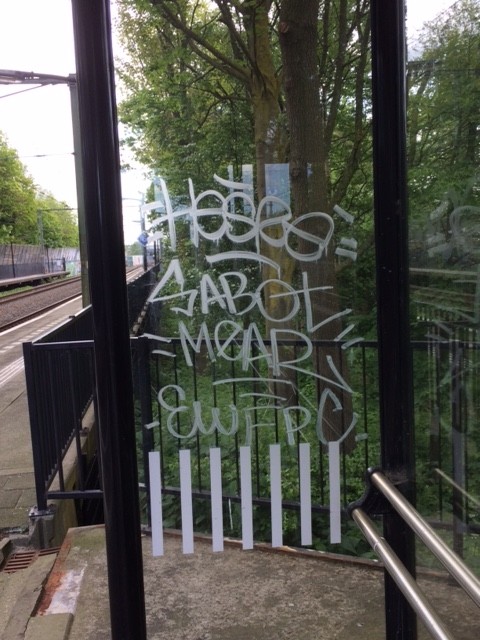
Successful anti-graffiti program
The anti-graffiti program in which Valerie was involved started in 2002. “The city was then preparing for the Olympic Games. The city council and the police worked closely together for the program. They kept a close eye on various locations. In addition, the city removed graffiti then charging companies that left graffiti on their premises after a removal request from the municipality. This ensured that after three years, 90% less graffiti was found on facades and 80% less in alleys. Now that this joint effort is no longer there, you unfortunately see the graffiti problem returning.”
Less graffiti in three steps
According to Valerie, three things are important in curbing the graffiti problem: reporting, recording and removing. “It starts with creating a place where people can report graffiti damage. It is then important that tags are recorded or documented. You can eventually recognize graffiti writers by their tag. In a city like Amsterdam this is very difficult. For graffiti writers, Amsterdam is the Las Vegas of Europe. That's where graffiti writers can go to party. The people you are looking for can therefore also come from the other side of the ocean. Then try to find them. This is only possible if police forces worldwide work together intensively. But their priorities usually lie elsewhere.”
That is why the third point is the most important in Valerie's opinion: remove graffiti damage quickly. People feel safer in an environment without graffiti. If you quickly remove graffiti as a rail company, you also show travelers that you understand what is important to them.”
Secure design and management
In addition to working according to the three-stage approach report-record-remove, Valerie points out another method that has now proven effective in reducing the graffiti problem: 'crime prevention through environmental design' or CPTED. Called 'safe design and management' in the Netherlands. With CPTED you ensure that an environment is designed, used and managed in such a way that unwanted behavior is reduced and desired behavior is stimulated. “For example, bring eyes to the area,” Valerie explains. “Provide clear situations, make streets and paths wider and create places to sit in a clearly visible area. People then feel safer, while the area becomes less attractive for graffiti writers.”
Small intervention, big effect
Valerie illustrates that combating vandalism based on the CPTED idea does not have to be complicated with an example from a Vancouver neighborhood: “Graffiti writers often defaced electricity boxes and the walls in alleys. Community members then put up a sign making it clear that the area was a children's play area. As a result, more and more people came who find it important that children can play quietly there, and graffiti writers ultimately stayed away.”
Discourage graffiti sprayers
Based on her experiences, Valerie also gives some practical tips for station environments to discourage graffiti sprayers. “For example, cover walls with plants or provide them with a protected mural. Spraying graffiti is then less attractive on these walls because tags are not clearly visible on such a surface. You can also apply anti-graffiti foil to graffiti-sensitive objects such as trains, trams, buses or utility boxes.” More and more rail companies are choosing to protect equipment with foil. If a train, tram, metro or bus is provided with anti-graffiti foil, graffiti can be easily removed, using more human and environmentally friendly means, without leaving traces on the equipment. The foil ensures that the preservation layer remains intact after the graffiti is removed.